
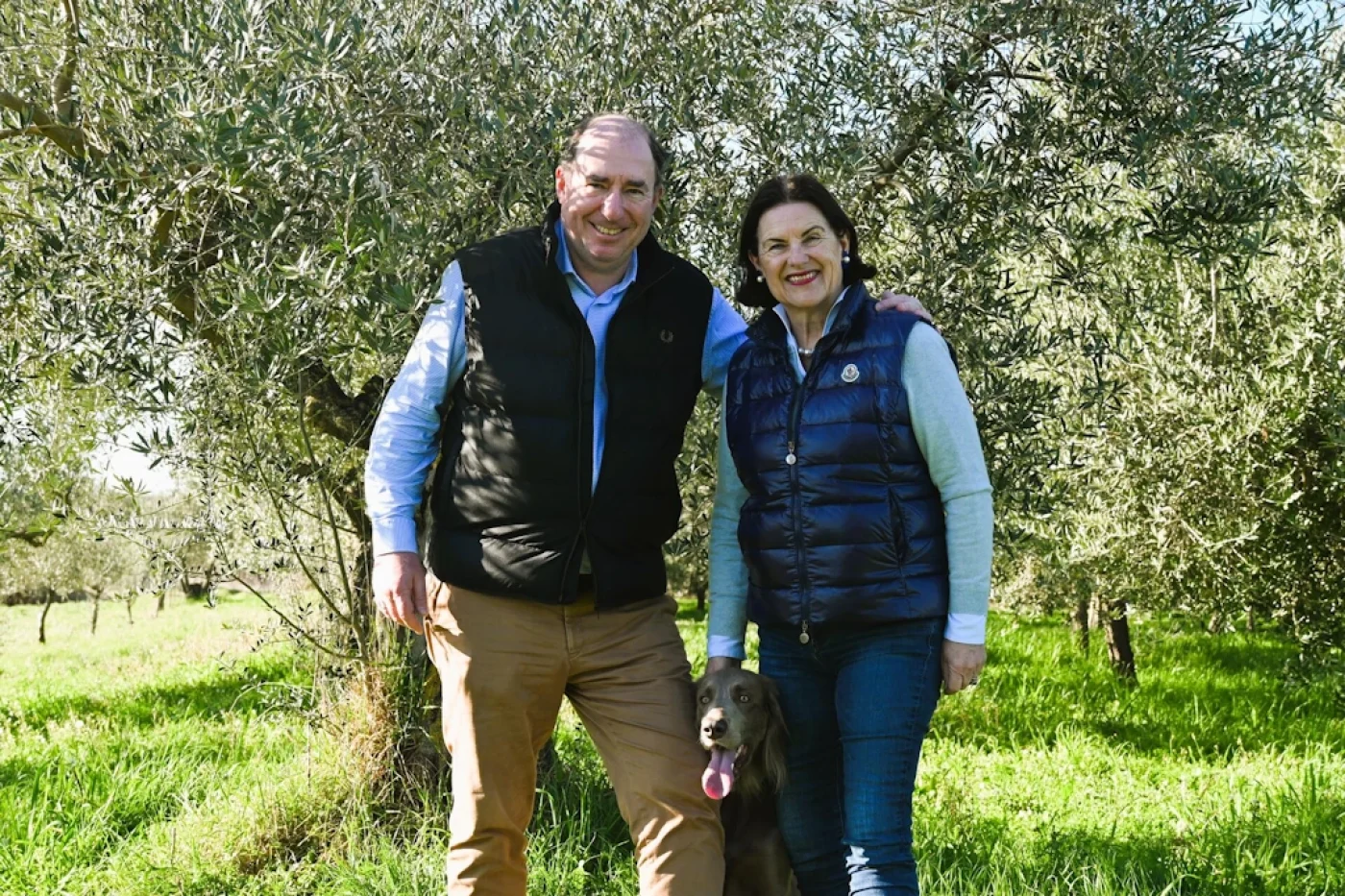
The story of Avistria is an inspiring testament to Austrian olive oil, and how entrepreneurial passion, originating in Austria, can conquer and redefine the international market for extra virgin olive oil. The protagonists of this exceptional narrative are Beatrix and Rudolf Nemetschke, a married couple of entrepreneurs whose home base is in St. Gilgen, on the shores of the idyllic Wolfgangsee in Austria. However, it was their deep love for olive oil that led them to make a bold and visionary investment in the Istrian peninsula, Croatia. This decision forged a brand that is today synonymous with global excellence, giving rise to what, by ownership and vision, can be considered a genuine Austrian olive oil with a Mediterranean soul.
The Austrian lineage is the backbone of this project. Even though the olive trees grow under the Istrian sun, the ownership of the plantations is 100% Austrian family-owned. Rudolf Nemetschke, a former investment banker, and his wife, a business consultant, brought their expertise in precision and management to the field of olive growing. Their original dream was to raise rare cattle breeds in the Austrian Salzkammergut, an aspiration that was frustrated by strict national agricultural regulations. This legal barrier, far from extinguishing their vocation for agriculture, reoriented their focus towards their favorite vacation region, Istria, a place with a deep historical heritage as a former Venetian bishopric.
The key moment for the birth of Avistria occurred between 2013 and 2014, when the agricultural lands previously managed by the Yugoslav state were returned to their legitimate owners. The Nemetschkes seized this opportunity to acquire various plots from locals, thus establishing the foundation for their company. This entrepreneurial move, crossing national borders, is a quintessential example of Austrian passion for uncompromised quality. They currently manage several plantations totaling around 35 hectares in Sveti Lovreč. About 400 olive trees, some centuries-old, coexist there alongside more than 9,000 young plants that guarantee the future of their Austrian olive oil production.
The international success of Avistria’s Austrian olive oil is undeniable and serves as a validation of their rigorous approach. In the prestigious New York International Olive Oil Competition (NYIOOC) of 2025, the brand garnered impressive recognition: four Gold Medals for its Buža, Leccino, Istrian Blend, and Istarska Bjelica varietals. This achievement definitively consolidates their Istrian plantation as one of the elite addresses for Premium olive oil globally. The 2025 milestone follows an already award-winning trajectory; in 2023, Avistria had already won seven Golds in the same competition and was listed by the respected German gourmet magazine Der Feinschmecker among the 30 best olive oils in the world. Even renowned chefs, such as the acclaimed Austrian cook Johann Lafer, have declared themselves admirers of their oils’ profile.
The production philosophy is a fusion of indigenous Istrian tradition and a precision that could well be called Austrian. Avistria’s focus is on the production of **”green” extra virgin olive oil**, which involves an early harvest, carried out as early as the end of September, as was the case in 2025. This premature harvesting method is crucial, as it maximizes the content of polyphenols, powerful antioxidants that give the oil its intense aromas and characteristic pungency. The plantation cultivates both native Istrian varieties and rare, pungent Italian varietals. Although the early picking leads to a lower oil yield (around 2,000 liters for 2025), the Nemetschkes’ priority is quality over quantity, with a long-term goal of 25,000 liters.
The production of Austrian olive oil under the Avistria seal follows a meticulous process. The olives are pressed immediately after harvest in a high-quality oil mill. The key is that they are pressed together with the pit, thus preserving the integrity of the aromas. Subsequently, the oil undergoes a gentle fermentation process, using a new and crucial technique: it is done without filtration, which allows the oil to retain all its nutritional and flavor elements. Bottling is carried out autonomously under a strict proprietary quality protocol, the so-called “Codex Avistriae.” This code guarantees the highest standards at every stage, from the manual picking of the fruit to the final sealing of the bottle, ensuring the consumer a premium product of unparalleled quality.
Finally, the Austrian connection is closed with distribution. Avistria’s Austrian olive oil, though forged in Istria, is designed to be directly accessible to its originating public. It is available in selected Austrian specialty stores, including the Vinothek St. Stephan in Vienna and points of sale in St. Wolfgang and Bad Ischl. Furthermore, the brand has optimized distribution for its compatriots through its new web shop, offering the oils at unified “Ab-Hof-Preise” (direct-from-the-farm prices). Avistria is, in essence, the successful materialization of the Austrian vision to bring the highest Mediterranean quality directly to the Austrian table.
The expansion of olive cultivation northward, driven by global warming, is marking the emergence of Austria as a new and surprising production region, a phenomenon perfectly summarized by the term Austrian olive oil.
The article details how climate change is redefining agricultural zones, making traditional cultivation in Mediterranean regions, such as Croatia, increasingly unsustainable. In Dalmatia, Croatia, the 2024 olive harvest was considered “not so good.” Producers like Milenko Zagorac, who has been growing organic olives since 2006, confirm that every year is hotter, with an increase in extreme weather events. The year 2024, for example, was the hottest on record in Croatia, requiring costly and exhausting extra watering efforts, even for heat-adapted varieties.
The consequences of warming in the Mediterranean are severe: heat stress and drought divert the tree’s energy that should be used for fruit production, while mild winters create an ideal breeding ground for pests. Professor Tatjana Klepo, from the University of Split, an olive expert, confirms that the vegetative season has moved forward by one or two weeks. To counteract these adverse conditions, Klepo advocates for the search for more resilient varieties, including crossing cultivated olives with wild olives that have survived for centuries under harsh conditions.
The experts’ conclusion is clear: the olive cultivation zone will shift northward, away from the Mediterranean. It is here that the potential of Austrian olive oil comes into play, moving from theory to reality.
In Lower Austria (Niederösterreich), olive cultivation is being successfully trialed alongside other crops such as rice and edamame. South-facing slopes, with arid and nutrient-poor soils, appear to be “optimal for the olive” in their region.
Austria is also getting warmer: the typical minimum temperature in the east of the country has risen from -18 °C in the 1990s to the current -8 or -9 °C, making the climate much more benign for the olive.
The olive was the first exotic plant chosen for the association’s trials because it is a familiar symbol associated with Mediterranean holidays. Despite the challenges and the long process (olive trees take about ten years to fully produce), the viability is palpable. Currently, there are already more than 7,000 olive trees in Austria. Fink emphasizes that success depends not only on minimum temperatures but on the overall weather pattern and, particularly, the absence of snow.
Although the first Austrian harvests of 2024 are far from reaching Croatian volumes, the goal is for the production of Austrian olive oil to become a permanent part of Austria’s agricultural assortment. The olive tree, a robust and adaptable plant, offers hope for the agricultural future, whether in Dalmatia with new irrigation techniques or in its new home north of the Alps.
Important Note: aceitedelcampo.com promotes the consumption of extra virgin olive oil for its culinary qualities and health benefits. However, no medication or current treatment should be replaced without the guidance of a healthcare professional.
ALZAYT EXPORT SL
info@aceitedelcampo.com
C/ Eduardo Bosca 19, 2-5
46023 Valencia
Subscribe and receive a coupon by email for your next purchase.